
Tell a supplier during a negotiation that their prices have gone up a lot, and they will have an answer ready.
Tell them there have been four increases since January, +14 % compound, not one decrease, while the index came back down in March and again in June, and it becomes a different conversation.
You are stating a fact.
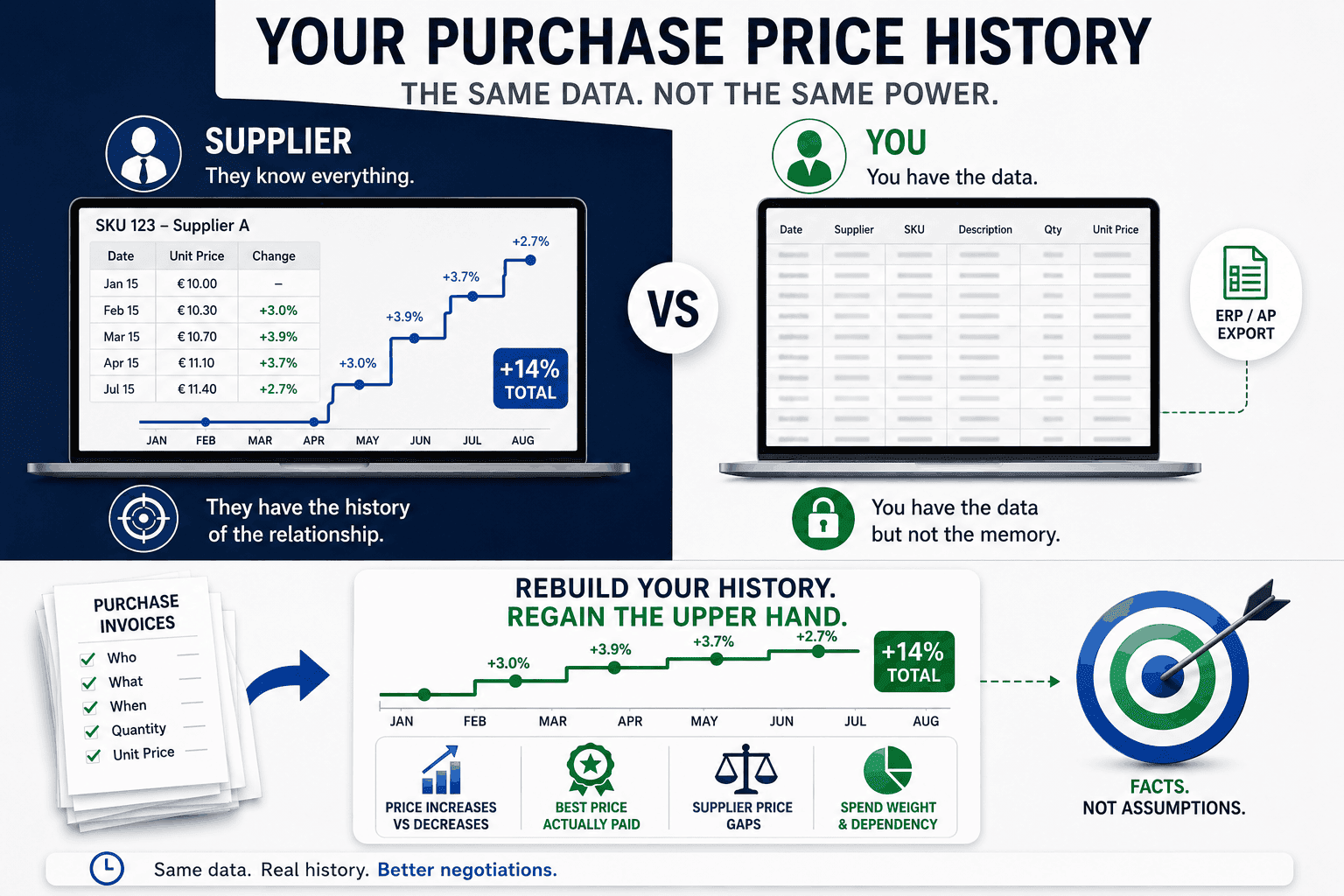
When a supplier sends you an annual price review, they have read the history before writing the email. Line by line, with dates. It sits in their CRM, and their account manager checked it.
You hold exactly the same information. It is in your accounts payable. It simply is not in a form that lets you answer within half a day.
That imbalance is not commercial, it is documentary. And it explains the rest: cost increases travel up the chain within weeks, decreases stop somewhere before they reach you. Not out of bad faith. Because only one of the two parties keeps the books on the relationship.
What it takes to hold that conversation
Nothing you do not already have.
No contracts to re-enter, no supplier price lists to chase, no new record-keeping. Two years of purchase invoice lines are enough: who, what, when, how much, at what price.
One caveat, and it takes thirty seconds to check: some accounting exports aggregate lines by ledger account rather than by item. When that happens the part number is gone, and everything below becomes impossible. Look at that first, before talking about analysis at all.
Four readings come out of it.
Asymmetry. For every supplier-item pair, compare the cumulative size of the increases against the cumulative size of the decreases over the period. A pair that has only ever been adjusted upward while its raw material corrected twice.
The best price you actually paid. For a given item, over twelve months, across all suppliers, applied to your real volumes. This is not a cost model, it is a fact drawn from your own invoices.
Gaps between suppliers in the same period. Same item or same family, bought in two places in the same quarter, at prices that diverge. The signature of an order placed with the usual supplier while an agreement exists elsewhere. And the cost is not only the price gap: a supplier who sees that promised volumes never materialise quietly stops offering their best terms.
Weight crossed with dependency. Each family’s share of your spend, crossed with the number of distinct suppliers actually used for it. A heavy family served by a single source is not a spend category, it is an exposure.
Why these four readings do not come out of a spreadsheet
The objection is fair: stack two years of exports, build a pivot table, and you get close. That is not where the problem is.
An ERP export is a photograph. You pull it on the 5th of the month and it tells you where you stand. The following month you pull another one, drop it below the previous one in a workbook, and call that a history.
Except an ERP is a living system. A unit price gets corrected three weeks after entry. An item gets reclassified when someone notices it has been in the wrong family for two years. A line gets reassigned to another supplier after a dispute. These corrections are legitimate, and they are retroactive.
The result: the November file no longer contains October’s version. It was overwritten, so it exists nowhere. You are stacking photographs and calling it a film.
Hence the architectural choice behind Clairvia: an import does not replace the previous one, it is added to it. Every line carries a fingerprint computed on its business key. If it comes back identical, it is discarded as a duplicate. If it comes back modified, we record which columns moved, with the value before and the value after.
Your history is one export per month. The file you pull is not worth much on its own. Kept, dated, compared line by line against the previous one, it eventually holds the one thing your supplier has and you do not: an exact memory of what they invoiced you.
Cédric Beaujon — Clairvia See what a purchase history reveals · Have your exports read